Guide
What Is a 3D Hologram Fan?
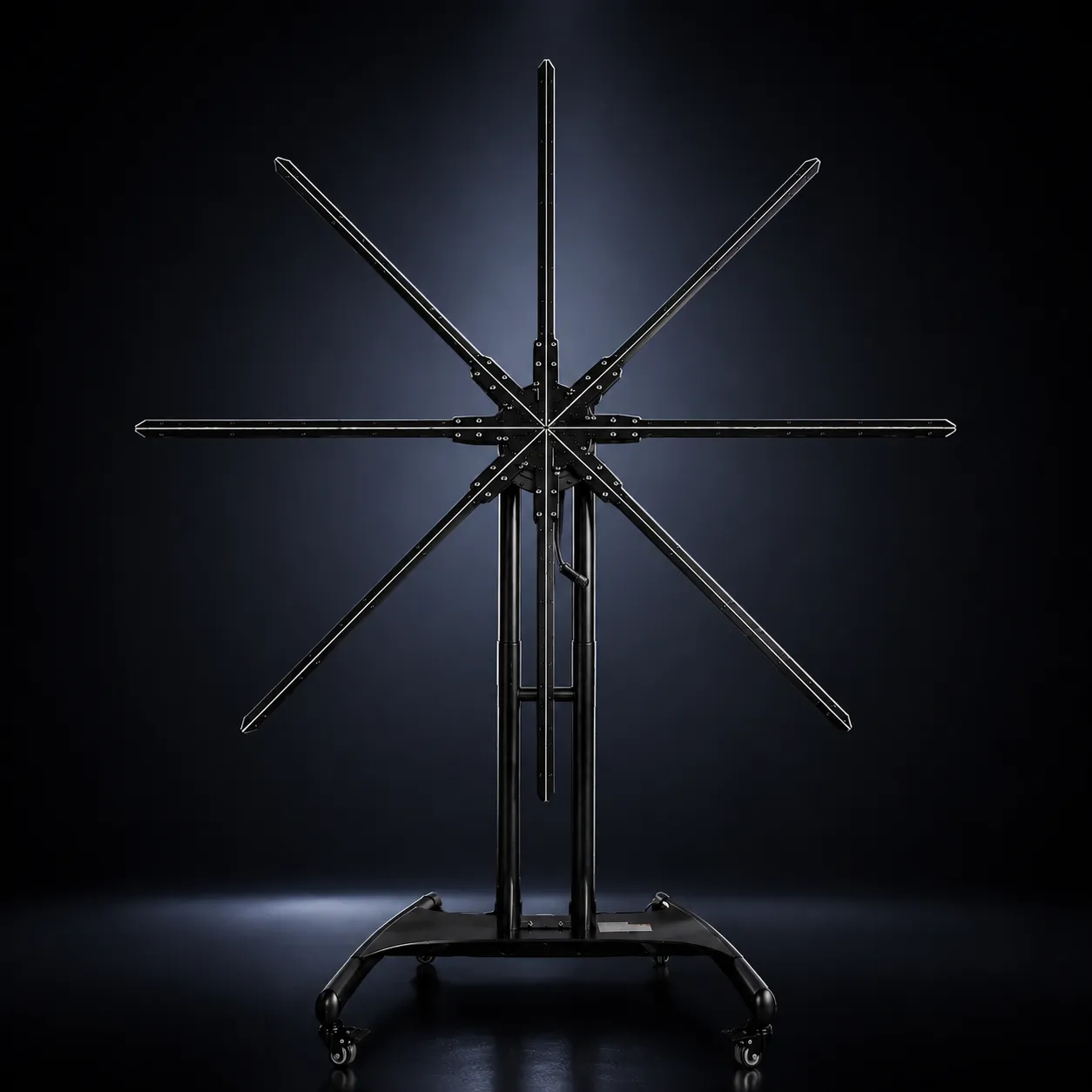
A 3D hologram fan is a digital display that uses rapidly rotating LED blades to create the appearance of an image floating in open space. Instead of projecting onto a wall or screen, the LEDs illuminate at precise points during rotation, creating a complete visual through Persistence of Vision (POV). These displays are commonly used for product showcases, trade shows, retail environments, events, brand activations, museums, education and other commercial installations.
A hologram fan is not a true optical hologram. It is a rotating LED display engineered to create a floating-image effect that appears three-dimensional to the viewer.
On this page
At a glance
- Display type Rotating LED blades
- How the image forms Persistence of Vision (POV)
- True optical hologram? No — a floating-image effect
- Screen or projection surface None required
- Strongest content Simple, high-contrast 3D objects
- Common uses Trade shows, retail, events, museums
How does a hologram fan create the floating image?
A hologram fan combines a high-speed electric motor, rotating LED blades, a control system, and synchronized media playback. As the blades rotate, individual LEDs turn on and off at extremely precise moments. Because the movement happens faster than the human eye can distinguish each individual position, the illuminated points appear to blend together into a complete image.
- 01
Load
Visual content is loaded onto or sent to the display.
- 02
Spin
The motor rotates the LED blades at high speed.
- 03
Time
The controller determines exactly when each LED should illuminate.
- 04
Draw
The LEDs create different portions of the image during each rotation.
- 05
Perceive
Your eyes perceive those rapidly changing light points as one continuous visual.
This effect is known as Persistence of Vision.
Is a hologram fan a real hologram?
Not in the strict optical definition of holography. Traditional holography records and reconstructs light information to reproduce the appearance of a three-dimensional object. A hologram fan instead uses rapidly rotating LEDs to create the perception of a floating image.
The term “hologram fan” became popular because the final visual can look as though an object, logo, character, or product is suspended in space without a traditional rectangular screen around it. Also called: 3D hologram fan, holographic fan, holographic fan display, LED hologram fan, 3D holographic display and hologram display fan.
What does a hologram fan look like in real life?
The viewing experience depends heavily on five factors: display size, content design, surrounding lighting, viewing distance and viewing angle.
The effect can look very different from a professionally rendered product video when experienced in person, so buyers should evaluate actual installation footage whenever possible.
HOLOFAN first-party viewing test
One display. One clip. Six viewing conditions.
Distance
Lighting
Angle
Common hologram fan sizes
Hologram fans are available in different sizes depending on the intended viewing environment and scale of the visual.
| Display size | Typical application | Best fit |
|---|---|---|
| 11.8″ | Compact, close-range displays | Counters and closer interaction |
| 25.6″ | Portable displays, counters, booths | Trade shows, product displays, smaller retail installations |
| 31.5″ | Medium commercial installations | Retail, exhibitions, events |
| 39.4″ | Larger focal displays | Trade shows, storefronts, brand activations |
| 59″+ | Large visual installations | Venues, experiential marketing, large commercial spaces |
| Multi-display | Large-format visuals | HOLOWALL™ and life-size configurations |
The largest display is not automatically the best choice. The ideal size depends on viewing distance, available space, content scale, installation type, and how dominant the holographic visual needs to be.
What content works best on a hologram fan?
Content design has a major effect on how convincing the holographic effect appears. The strongest content is usually designed specifically for the display instead of simply repurposing traditional video.
Generally works well
- Rotating products and animated product reveals
- Isolated 3D objects surrounded by negative space
- Logos and characters
- Metallic objects and particles
- High-contrast motion graphics
- Dark or transparent-looking backgrounds
Usually less effective
- Long paragraphs of text and small typography
- Crowded scenes and complex backgrounds
- Conventional full-screen video, where every part of the frame is illuminated
- Low-contrast visuals
- Detailed user interfaces
Where it’s used
Where are hologram fans used?
Hologram fans are used primarily in environments where businesses want to create a visually distinctive focal point.
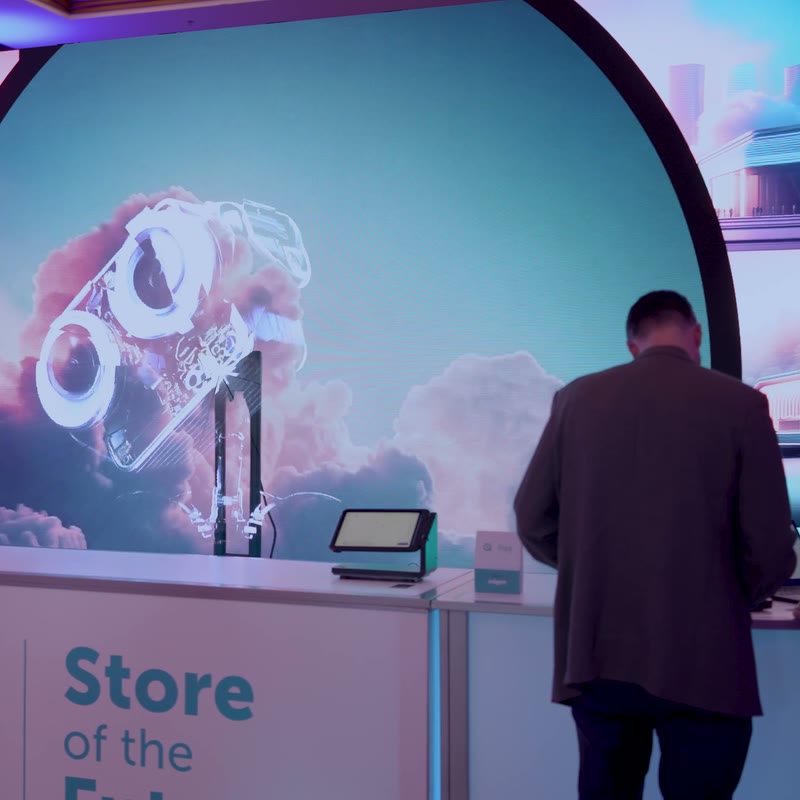 Trade ShowsShowcase products, logos, 3D models, or branded animations without adding another conventional rectangular screen to the booth.Trade show displays
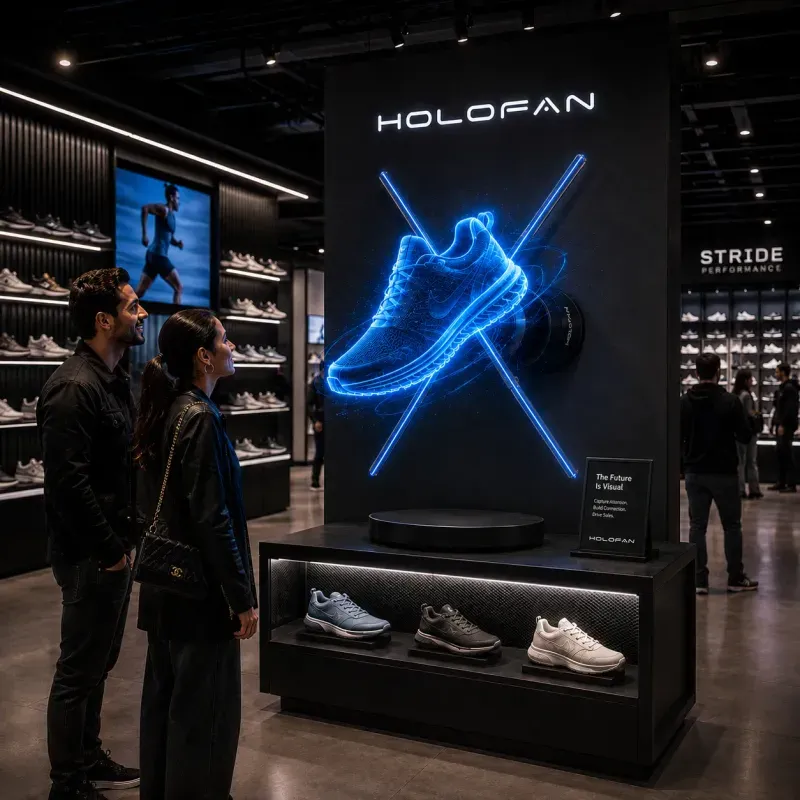 RetailProduct launches, window displays, feature products, promotional campaigns, or branded visual installations.Retail displays
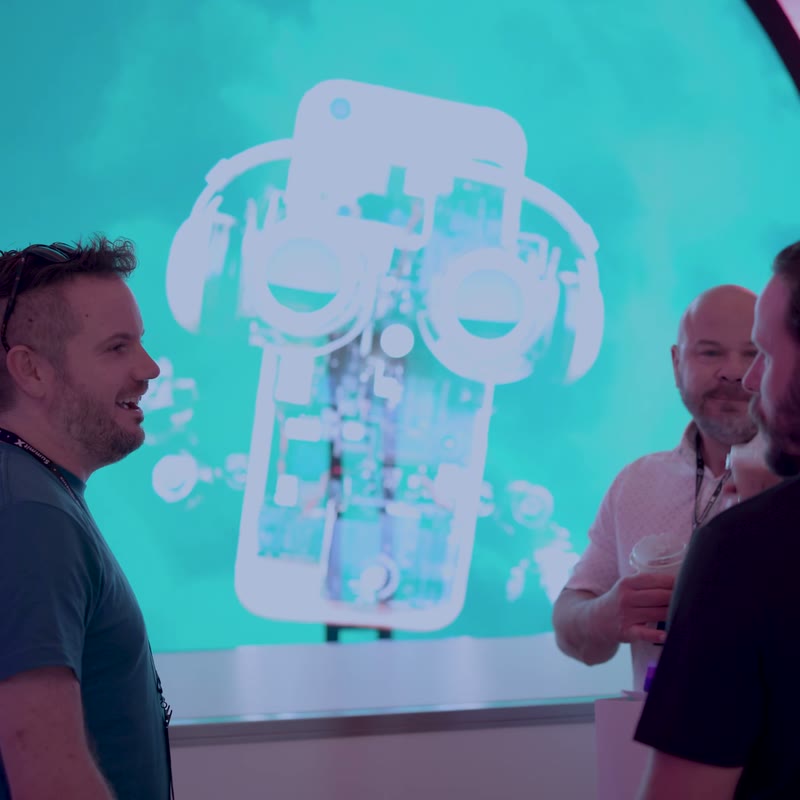 Events & Brand ActivationsVisual centerpieces for experiential campaigns, launches, entertainment, corporate events, and temporary installations.Event displays
Corporate Environments
Showrooms, offices, innovation centers, lobbies, conference spaces, and demonstration environments.
Museums & Education
Present models, objects, concepts, or historical reconstructions in a more visually dynamic format.
Education & museumsWhen does a hologram fan make sense?
A hologram fan is often a good fit when the goal is to create a visual focal point rather than display large amounts of conventional information.
Good fit when you need
- A floating-image appearance
- A visually unusual product presentation
- Compact digital signage
- Portable display hardware
- Reusable animated content
- 3D product visualization
- An experiential marketing element
- A display that does not look like a traditional TV
May not be ideal when
- Visitors need to read large amounts of text
- Conventional video playback is the primary objective
- Extremely wide viewing angles are required
- Outdoor daylight visibility is the dominant requirement
- The application requires a large seamless rectangular video surface
- The audience needs to view detailed UI or presentation slides
In those cases, an LED wall, television, projector, transparent LED display, or another display technology may be more appropriate.
How does a hologram fan compare with a projector?
Hologram fans and projectors solve different visual problems.
| Feature | Hologram fan | Projector |
|---|---|---|
| Projection surface required | No | Usually yes |
| Floating-image appearance | Yes | Requires specialized setup |
| Traditional video playback | Limited by display format | Excellent |
| Portable configurations available | Yes | Yes |
| 3D-object presentation | Strong use case | Possible with designed content |
| Large conventional image | Limited by display configuration | Strong use case |
| Works without visible rectangular screen | Yes | Usually no |
Neither technology is universally better. A projector is typically more appropriate for large conventional video, presentations, and content-heavy visuals. A hologram fan is better suited to isolated objects, products, logos, characters, and other content intended to appear suspended in space.
How do you choose the right holographic display?
The correct system depends more on the application than simply choosing the largest model.
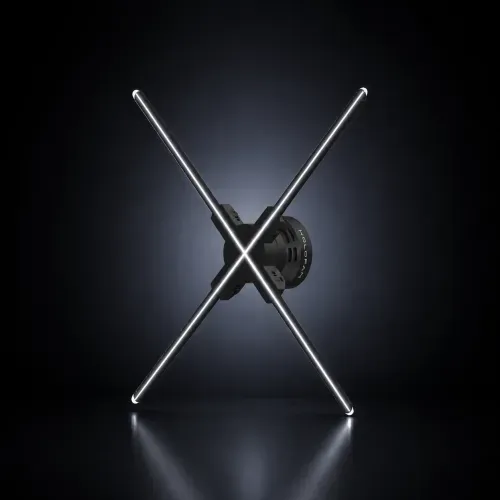 App-Controlled HOLOFANChoose when content can be preloaded and campaigns change periodically.Standalone installationSimple content managementRetail, exhibitions, events, promotions
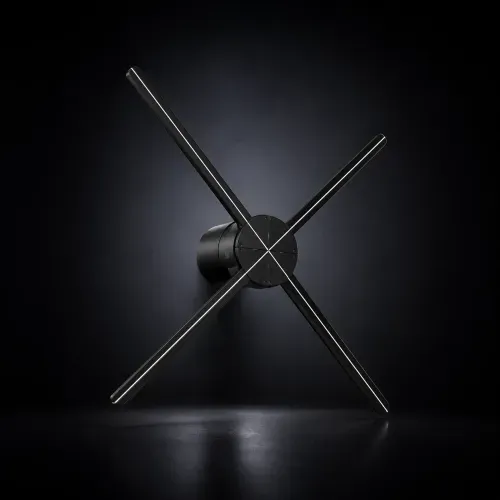 HDMIChoose when content needs to update in real time.Live video inputInteractive softwareLive production systemsLatency matters
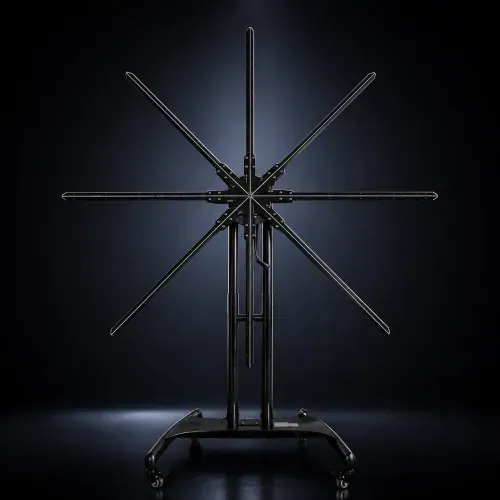 Large Format / MAXChoose when one larger display needs to carry the visual — 59″ and 79″.VenuesExperiential marketingLarge commercial spaces
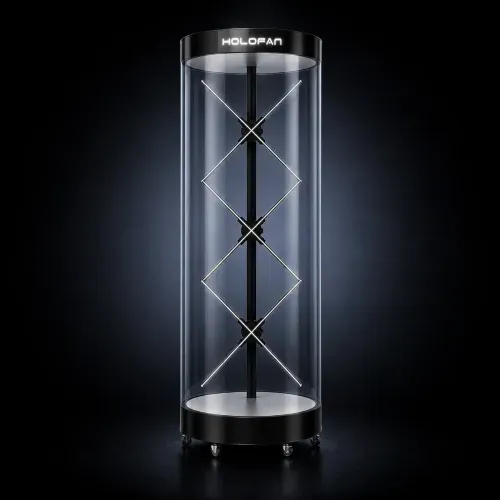 HOLOHUMAN™Choose when you need a vertical, human-scale visual with life-size presence.PresentersDigital charactersAmbassadors and concierges
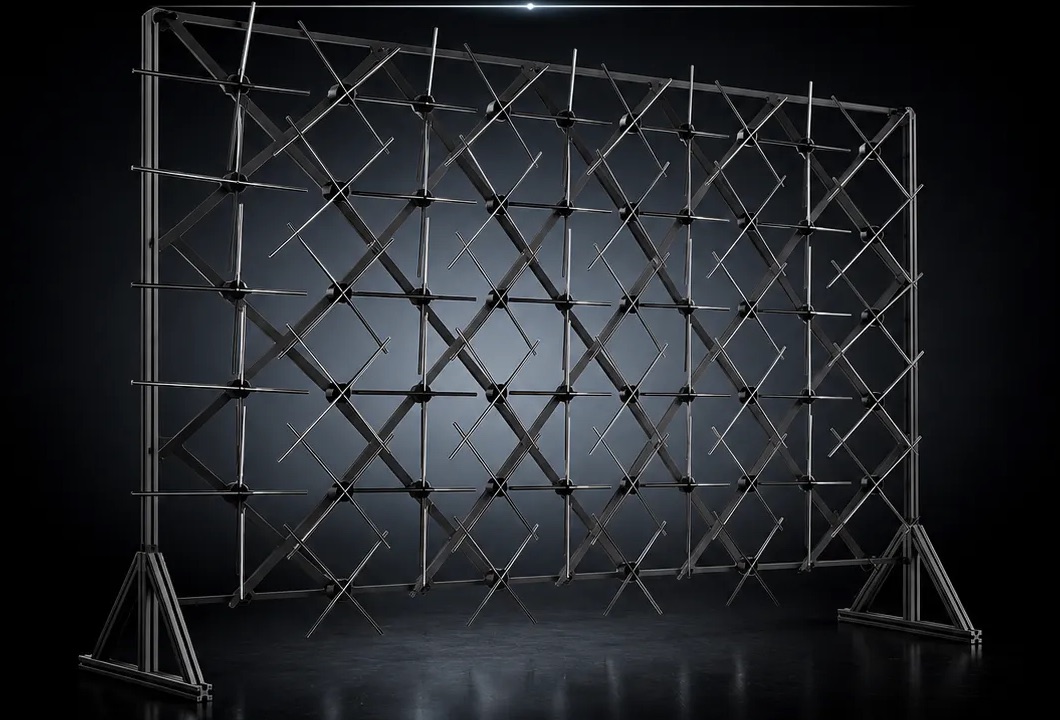 HOLOWALL™Choose when a single display is not large enough.Larger visual canvasMultiple synchronized unitsPrimary visual centerpiece
Real-world HOLOFAN examples
How it performs in real commercial environments.
FAQ
Frequently asked questions.
Short answers to the questions buyers ask most.
Does a hologram fan use a projector?
No. A hologram fan produces the image using LEDs mounted to rotating blades. It does not require a projection surface.
Can I upload my own videos, logos or animations?
Yes. HOLOFAN displays can play compatible custom video and animation content using the HOLOFAN app, PC, USB or supported input method depending on the model.
Can hologram fans display video?
Yes, although conventional full-frame video is not always the best use of the technology. Content with isolated objects, strong contrast, and 3D movement generally produces a more convincing floating effect.
Do hologram fans work in bright rooms?
They can be used in illuminated indoor environments, but perceived contrast depends on the display's brightness, surrounding lighting, content, viewing angle, and installation.
How far away should viewers stand?
The ideal distance varies by display size and installation. Larger displays generally support viewing from farther away, while smaller displays are often better for counters, booths, and closer interaction.
Can multiple hologram fans be synchronized?
Some multi-display configurations support synchronized or coordinated playback, but compatibility depends on the model and system configuration. HOLOWALL™ and HOLOHUMAN™ are designed as multi-display systems. Confirm compatibility before planning a custom multi-unit installation.
Can hologram fans display people?
Yes. Human footage or rendered characters can be adapted for holographic display, although content preparation and display scale matter significantly. For life-size applications, multi-display vertical configurations can provide a more appropriate scale.
What video format does a hologram fan use?
Supported file formats depend on the specific display and content system.
About HOLOFAN
Commercial holographic displays, content and support.
HOLOFAN provides commercial holographic display hardware, custom visual content, large-format holographic systems, and deployment support for retail, trade shows, events, installations, and enterprise applications.
About this guide
About HOLOFANContinue learning
Go deeper on holographic displays.
Ready to Build a Holographic Display?
Explore HOLOFAN's holographic displays for retail, trade shows, events, product showcases, and enterprise installations.