
Education & museum holographic displays
Bring concepts, exhibits and stories to life in three dimensions.
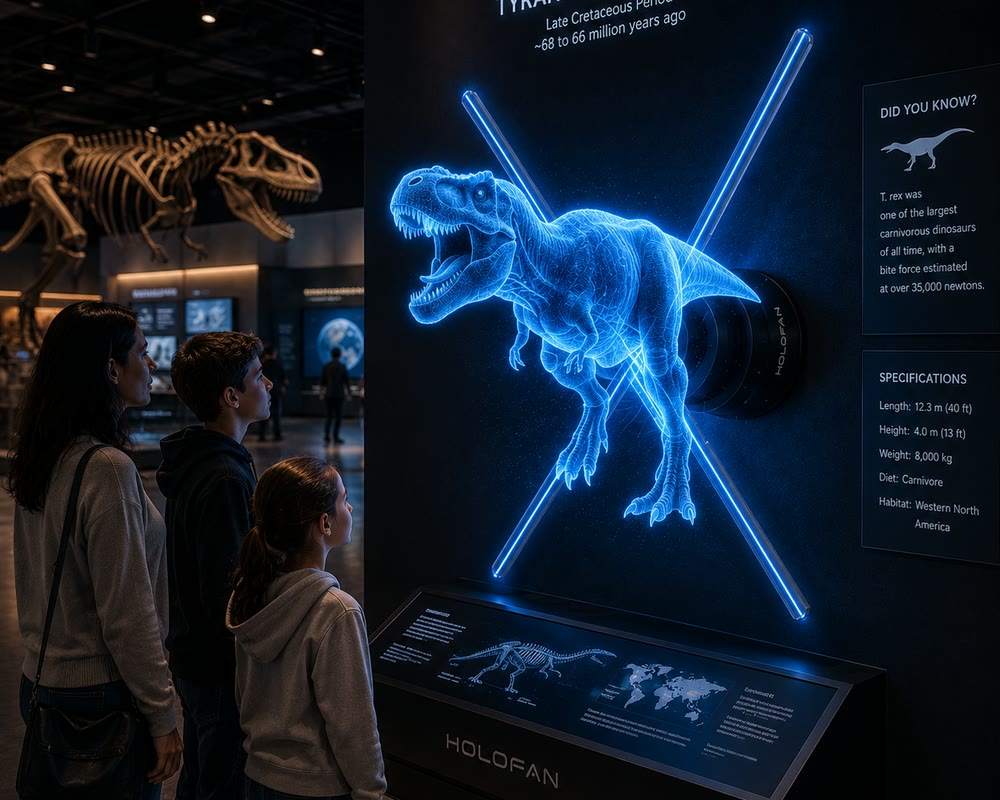
Use holographic displays to visualize complex ideas, historical objects, scientific concepts, characters, artifacts and educational content in a format designed to support learning and exhibit storytelling.
The challenge
Some ideas are easier to understand when you can see them in space.
Textbooks, diagrams, models, screens and display cases all have their place. A holographic display adds a dimensional visual layer that can help show form, scale, movement, internal structure and context.
Flat formats for 3D subjects
Diagrams, posters and conventional screens show dimensional subjects on a flat surface, so form and spatial relationships can be hard to read.
Objects that can’t be shown
Some subjects are too fragile, too large, too small or inaccessible to place in the room.
Concepts without a physical form
Processes, systems and historical context often have no object to point to.
Costly to replicate
Physical models and replicas can be difficult or expensive to make for every lesson or exhibit.
What HOLOFAN can do
Holography across the learning and exhibit journey.
See
Make the concept visible: anatomy, astronomy, engineering, architecture, chemistry, historical objects, archaeological artifacts and mechanical systems.
Understand
Show how things work with exploded views, internal systems, rotation, layered anatomy, mechanical movement, cause and effect, transformations and timelines.
Explore
Present the subject from new angles with multi-angle viewing, virtual artifacts, guided presentations, digital characters and narrated exhibit moments. Interactive elements are scoped per project with compatible external systems.
Remember
Create a strong visual anchor within a lesson or exhibit that supports the educational or exhibit objective, rather than novelty alone.
Key applications
Where holographic displays fit in education and museums.
Science & STEM
Anatomy, molecules, planetary systems, physics demonstrations, robotics and mechanical systems shown in three dimensions.
Medical & anatomy education
Visualization of anatomy, organs, devices, biological systems and procedural concepts for teaching, not clinical use.
Engineering & technical training
Machinery, components, exploded views, assembly sequences and technical processes for training and demonstration.
Historical artifacts & reconstruction
Digital reconstructions of fragile or damaged artifacts, fossils, extinct species and historical structures that can be rotated, enlarged or exploded.
Museums & cultural exhibits
Cultural objects, architecture, heritage and visual narratives that extend interpretation beyond the display case.
Higher education & innovation centers
Labs, research showcases, innovation centers and presentation spaces for experiential learning.
Recommended systems
Recommended HOLOFAN systems for education and museums.
Start with the learning or exhibit objective: viewing distance, audience size, lighting, accessibility, available footprint and content all shape the right format.
HOLOFAN
App-controlled holographic displays for tabletop exhibits, artifacts, scientific objects, focused demonstrations and smaller learning stations.
HOLOFAN HDMI
Real-time holographic display for live content from laptops, media players and cameras, for guided presentations, changing visualizations and externally controlled content.
HOLOHUMAN™
Life-size vertical presentation for historical figures, narrators, educators, museum guides and character-based storytelling.
HOLOWALL™
Modular multi-display installations for larger museum installations, science exhibits, experiential learning spaces and large-format storytelling.
Custom 3D content
Turn complex ideas into understandable visuals.
HOLOFAN’s 3D team works from CAD, 3D scans, photogrammetry, museum photography, archival material, illustrations, research data or existing models. An original object or scan becomes a 3D reconstruction, then a holographic exhibit: a digital representation, never the original artifact.
- Scientific models
- Anatomy
- Artifacts
- Historical reconstructions
- Mechanical systems
- Architectural models
- Characters
- Educational animations
- Exhibit visuals
Educational content should clarify, not just impress. Clean 3D models, sparing labels, exploded views, highlighted components, controlled animation, clear scale references and step-by-step sequences work best; avoid dense paragraphs, tiny labels and decorative motion. Conventional screens remain better for detailed reading, long video and dense data, and holographic displays usually complement physical artifacts rather than replace them.
How deployment works
From learning objective to installed exhibit.
Define the objective
Share the subject, audience, environment, lesson or story and the experience you want to create.
Select the display format
Scope display type, viewing distance, mounting, enclosure needs, the environment and accessibility considerations.
Build and review content
Use existing 3D models, scans, CAD, illustrations, archival material or video, or create custom content, then review clarity, scale, timing, readability, viewing angle and visitor flow.
Install and launch
Deploy the approved system and validate the final experience in the space.
Installation requirements and timing are scoped during project planning.
Proof
Real projects in this environment.
Hidden until real, client-approved projects exist.
Can HOLOFAN display historical artifacts or reconstructed objects?
Yes, as digital 3D representations. Artifacts, fossils, historical structures, spacecraft or microscopic systems can be reconstructed when suitable source material such as scans, photogrammetry, CAD or archival imagery exists or can be created. A reconstruction is a recreated visual, not the original object.
Can a real person or historical figure appear in the display?
Yes, as prerecorded presenters, performers, reconstructed characters or digital figures, including multilingual versions. Any live or interactive element depends on compatible external systems and is scoped per project.
Which HOLOFAN system is best for museums and educational spaces?
It depends on the objective, audience size and viewing distance. HOLOFAN displays suit focused objects and learning stations, HOLOHUMAN™ suits narrators and historical figures, and HOLOWALL™ suits larger exhibits and experiential spaces.
Book a demo
Turn complex ideas into dimensional experiences.
Tell us what you want to teach or exhibit, who the audience is, where the display will be installed and what source assets already exist. We can help scope the right display, content and deployment approach.
How can we help?
Whether you're looking to purchase a display or need support with an existing system, our team is here to help.

Expert Customer Support
International Shipping
Custom Solutions Available
Trusted By Brands, Events & Organizations Worldwide
Dedicated Support Team
Ready to get started?

Get a Tailored Quote
Share your requirements, timeline, and budget.
Tell Us What’s Going On
Include your order number so we can help faster.
Describe Your Vision
Share your idea, goals, and timeline.
Explore a Partnership
Tell us about your business and goals. We’ll review and follow up.